

The Province of Ontario is implementing significant changes to waste diversion and recycling under the Blue Box Regulation (O. Reg 391/21). These changes support the transition to a full producer-responsibility system, where those who create packaging play a larger role in managing it at end of life.
These updates begin affecting businesses on January 1, 2026, and we want to ensure Clarington businesses understand how they may apply to your operations. As the Clarington Board of Trade (your local chamber) our priority is to keep you informed, supported, and equipped to navigate these changes with confidence.
What Changes are Coming
For Small Businesses Receiving Municipal Blue Bin Service
Beginning January 1, 2026, Region of Durham blue bin recycling collection for small businesses will end.
The final day of municipal pickup will be December 31, 2025. After this date, small businesses must secure private recycling and waste-collection services to manage their recyclables.
We recognize this is a significant operational shift, especially for storefronts, small offices, and businesses located in mixed-use or multi-tenant buildings that have traditionally relied on municipal service.
For Medium and Large Businesses — “Producers” Under the Regulation
Some businesses may have obligations under the Blue Box Regulation if they supply packaging or paper products to Ontario consumers.
A business may be considered a Producer if it:
- Manufactures packaged products,
- Imports packaged products into Ontario,
- Places a brand or private label on packaging, or
- Sells packaged products directly to consumers in Ontario.
- If your business meets one of these criteria, it may be required to:
- Register with the Resource Productivity and Recovery Authority (RPRA)
- Report annually the type and amount of packaging supplied in Ontario
- Meet collection and recycling requirements, often by joining a Producer Responsibility Organization (PRO)
- Contribute financially to the collection, processing, and recycling of Blue Box materials
Obligations vary based on business size, supply chain role, and the amount and type of packaging supplied. Not every medium or large business will qualify, but many will, and it is important to assess whether the regulation applies.
Why These Changes are Happening - and Why Businesses are Now Responsible for Their Own Recycling
The Ontario government has stated that the shift to a full producer-responsibility recycling system is intended to modernize the Blue Box program and address long-standing challenges in how recycling has been managed across the province. According to the Province, these changes are occurring for several key reasons:
- To Improve Recycling Efficiency and Outcomes
- Ontario’s recycling rates have been stagnant for years, with many materials ending up in landfills despite being technically recyclable.
- The Province believes that transferring responsibility to producers, who design and supply packaging will:
- Encourage better packaging design that is easier and more cost-effective to recycle
- Reduce contamination and improve the quality of recycled materials
- Increase overall recycling performance across Ontario
- To Create a Consistent, Harmonized Recycling System
Currently, recycling rules vary widely from one municipality to another. This inconsistency results in:
- Confusion for residents and businesses
- Higher costs for municipalities
- A fragmented recycling system that is difficult to manage
Under the new model, producers will run a single, province-wide recycling system with consistent rules and material lists. This means: - The same materials accepted everywhere
- Standardized collection
- Clearer expectations for businesses and residents
- To Shift Costs Away From Municipalities and Taxpayers
- For decades, municipal governments, and ultimately local taxpayers, have borne most of the cost of operating blue box programs.]
- The Province’s goal is to ensure that those who create packaging take responsibility for managing it at end-of-life.
- By shifting costs and responsibilities to producers, municipalities will save millions annually, and businesses will become more accountable for the packaging they place in the marketplace.
- To Align Ontario With Global Best Practices
- Extended Producer Responsibility (EPR) systems are already widely used in Europe, British Columbia, Several U.S. states, Other Canadian provinces
- The Province has emphasized that Ontario must modernize its recycling system to remain competitive and environmentally responsible. EPR is viewed as an industry-supported, internationally proven approach to improving recycling outcomes and reducing waste.
- To Support a Circular Economy
The regulation is part of Ontario’s broader Resource Recovery and Circular Economy Act, which focuses on:
- Reducing waste
- Reusing materials
- Keeping recyclable resources in the economy longer
The Province believes that when producers are responsible for the life cycle of packaging, they have a strong incentive to:
- Reduce unnecessary packaging
- Use materials that can be recycled more easily
- Invest in recycling technologies and infrastructure
These explanations come directly from the government’s stated objectives when introducing O. Reg. 391/21 and its supporting materials. Click here for more information.
Why Businesses Will No Longer Receive Blue Bin Pick-up from the Region
Although the Blue Box Regulation is primarily about shifting recycling responsibility to producers, it also fundamentally changes who is entitled to blue box collection services in Ontario.
Under the new model, blue box collection is only required for eligible sources, and the Province has clearly defined that businesses are not part of the “eligible sources” for the producer-run system.
- The new recycling system is for households — not businesses
Under Ontario’s updated Blue Box Regulation, the new producer-run recycling system is only required to service:
- Homes
- Multi-residential buildings
- Schools
- Long-term care/retirement homes
- Some public spaces
Businesses are not included, which means they are no longer eligible for blue box pickup.
- Municipalities in Ontario won’t run blue bin programs anymore
Municipalities must hand over their blue box recycling programs to producer responsibility organizations.
Once this happens:
- Municipalities lose control of the service
- They cannot choose to keep collecting from businesses
- Producers are not allowed to add businesses to their routes
- Businesses must now use private recycling services
- Because the new system does not cover commercial properties, businesses must arrange recycling services through a private provide
- Fees and pickup schedules will depend on the provider selected
- Why the Province made this choice
- Improving recycling for residents
- Making producers responsible for residential packaging
- Reducing costs to municipalities and taxpayers
The Province designed the new Blue Box system to focus on:
Their view is that businesses should manage their own waste separately through commercial recycling services.
Why This Feels Sudden to Businesses
Although the changes to Ontario’s Blue Box system may feel abrupt, the transition to a full producer-responsibility model was actually announced several years ago when the Province introduced Ontario Regulation 391/21 under the Resource Recovery and Circular Economy Act.
However, despite the early introduction of the regulation, many businesses were not directly engaged or informed during the development and rollout stages.
Communication from the Province and its regulatory partners has largely been directed at producers, municipalities, and waste management associations, not everyday businesses that currently have their blue bins picked up or supply packaged products. Guidance and plain-language explanations have been slow to reach businesses.
Frequently Asked Questions
The Region of Durham has provided answers to questions businesses may have about this transition:
Yes, Blue Box material is accepted for recycling at any Regional Waste Management Facility. These are in Brock, Scugog, and Oshawa. The regional 2026 proposed budget includes waiving the fees at Waste Management Facilities for Blue Box materials. Any fee reduction would be subject to Council approval.
Approximately 2,800 small businesses in Designated Business Areas throughout Durham and approximately 200 additional small businesses that are not formally included in Designated Business Areas are impacted.
Small businesses must arrange for private recycling collection services by partnering with waste management companies that specialize in recycling services. The Clarington Board of Trade is in discussions with Miller Waste who have stepped forward to offer private recycling pick-up for a fee – and they will also provide bins at no charge (more info under “Support & Solutions”).
Municipal garbage, green bin, and leaf and yard waste collection will remain unchanged.
Residents living above businesses, including those in local Designated Business Areas will continue to receive Blue Box recycling collection services from Circular Materials.
No. Ontario legislation frames the Blue Box program as being residential only. While some municipalities, like Durham did, added Business Improvement Area and other small business as a convenience to its downtown core businesses Producer Responsibility Organizations, the Blue Box program never actually included a provision for businesses. The Region’s savings from transitioning from the Blue Box program was reinvested into the expansion of the Green Bin program which now includes a significant number of new materials and was expanded to include multi-residential buildings.
Yes, businesses may take recycling home and set out on their scheduled curbside collection day. There is no limit to the amount of recycling a residence can set out.
Under By-law 2024-009, owners and occupants must not set out garbage that includes Blue Box materials for collection.
There will be no by-law changes because of this change as the current by-law already prohibits all divertible materials from being placed in the garbage for curbside collection. This includes blue box recyclables.
The Region’s By-law compliance team complete regular patrols to ensure compliance with the waste management by-law.
Rental property owners are ultimately responsible for the maintenance of their properties. This includes from the outcome of the actions or behaviours of their tenants. Residents living above businesses, including those in local Designated Business Areas will continue to be permitted to set out Blue Box materials recycling for collection services from Circular Materials.
Yes. These organizations are treated as businesses. This includes: Charities, Non-profits, Churches, Community organizations, Small and medium businesses, Any industrial, commercial, or institutional (ICI) property. Because they are not considered residential properties, they are not included in the new blue box program and will no longer receive municipal blue bin pickup.
Solutions
The final day of Region of Durham blue bin recycling pickup for businesses will be December 31, 2025. After this date, small businesses must secure private recycling and waste-collection services to manage their recyclables.
OPTIONS TO MANAGE RECYCLING
Recycling Pick-up
The Clarington Board of Trade is working with Miller Waste who has stepped forward to offer a streamlined recycling pick-up service for Clarington businesses.
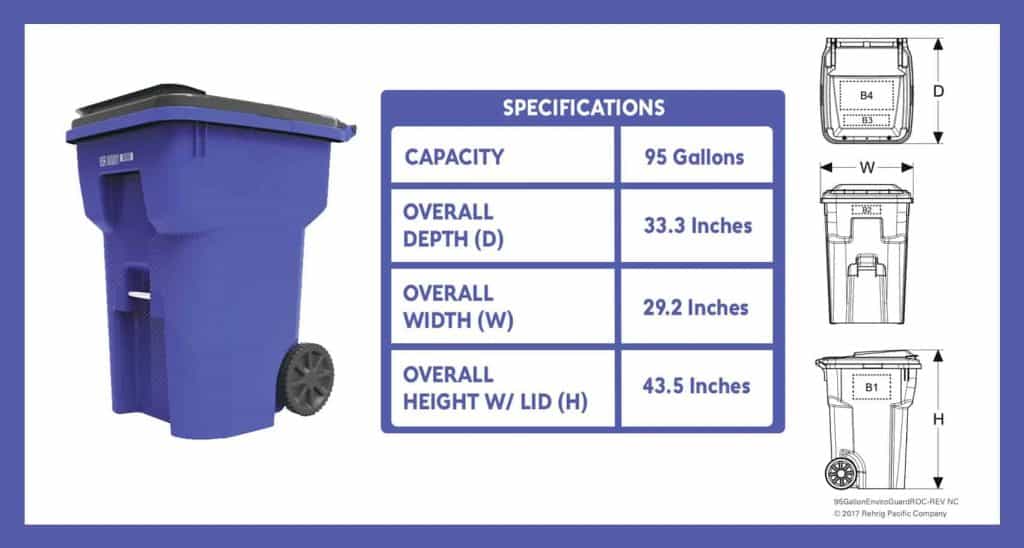
95-gallon totes to hold recycling materials are included in their service (one tote is equivalent to 4-5 blue bins).

For information and pricing, please contact David Tabuas, Miller Waste at 905-744-8531 or [email protected]
Blue Box material is accepted at Regional Waste Management Facilities
These are in Brock, Scugog, and Oshawa. The regional 2026 proposed budget includes waiving the fees at Waste Management Facilities for Blue Box materials. Any fee reduction would be subject to Council approval.
Click here for list of facilities accepting recycling.
Small Business Recycling can be Taken Home
Businesses may take recycling home and set out on their scheduled curbside collection day. There is no limit to the amount of recycling a residence can set out.
Support & Resources
Support from the Province
This is a statement from Todd McCarthy, Minster of the Environment in a letter dated November 27, 2025 to the Bowmanville BIA with the Clarington Board of Trade copied:
“Our government recognizes the importance of blue box recycling for residents and businesses and is committed to the best possible blue box system for both producers and municipalities. Over the coming year, we will be considering improvements to the system. As this occurs, we will explore how changes to the Blue Box Regulation could leverage the producer-run system to support communities, small businesses and institutions in maintaining cost-effective blue box services.” Click here to access the letter.
CBOT will provide more information from the Province as updates are shared with us.
Support from the Region of Durham
Statement taken from the Region of Durham Notice dated November 14, 2025:
“We understand this transition may require some difficult adjustments and we encourage businesses to secure private recycling collection services ahead of the December 31 deadline. Durham Region will continue to advocate on behalf of its small businesses and to will continue to explore future options to help its small businesses recycle.
If you have questions about these changes, please dial 311 (within Regional limits), call 1-800-372-1102, or submit them by email to [email protected].
Click here to access the notice.
Support from the Clarington Board of Trade
We understand that these legislative changes create uncertainty and operational challenges. We want you to know that CBOT is in your corner throughout this transition.
We are actively:
- Communicating with the Region of Durham, the Province, and community partners
- Monitoring provincial guidance and clarification as details continue to evolve
- Helping businesses determine whether they may qualify as producers
- Collecting information on expectations, deadlines, and compliance requirements
- Sharing resources to help small businesses secure private recycling services
- Identifying practical solutions and opportunities to minimize disruption
We are learning how to navigate these changes just as you are. If you have questions about how these changes may affect you, whether you are unsure about producer status or need to explore private recycling options, please reach out. We are committed to guiding Clarington businesses impacted by this change through every step of this transition.
Contact Bonnie Wrightman, Executive Director, Clarington Board of Trade 905-623-3106 or [email protected]
Click here for more information on Ontario’s Waste Diversion Program.
For Producers, Importers or Sellers of Products with Packaging
CBOT has spoken with the Ministry of Environment requesting guidance on how medium and large businesses who produce, import or sell products/packaging are affected as well as clarification on their expectations on what they need to do to comply and navigate this new legislation.
How Can We Help?
Feel free to reach out to Bonnie Wrightman at the Clarington Board of Trade, with any questions.